| Information |  | |
Derechos | Equipo Nizkor
| ||
| Information | | |
Derechos | Equipo Nizkor
| ||
13Mar26
Bahía Blanca: Oral trial requested for six former military personnel accused of crimes against humanity against 30 former members of the National University of the South
The Prosecutor's Office accuses them of kidnappings, unlawful detention, and torture committed in 1976 as part of a plan of political persecution targeting students, professors, and officials of that university community.
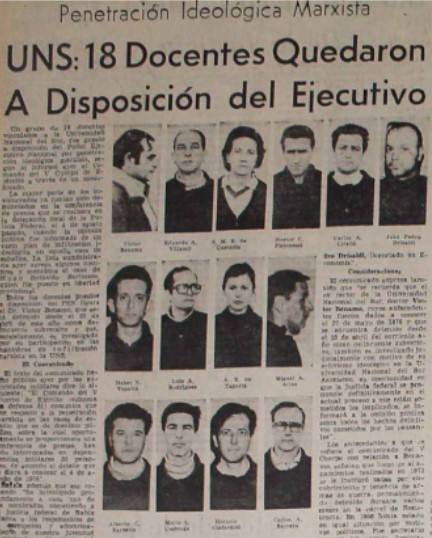
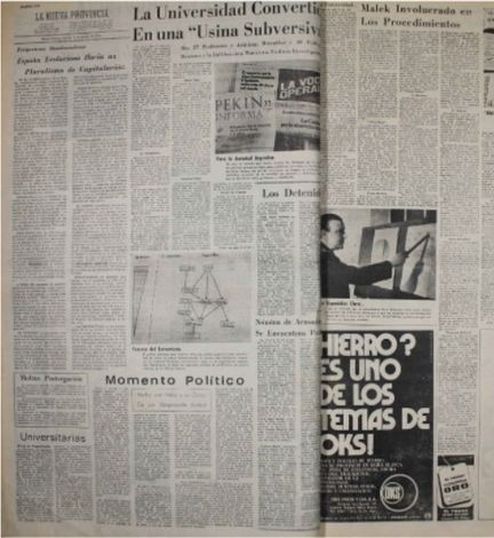
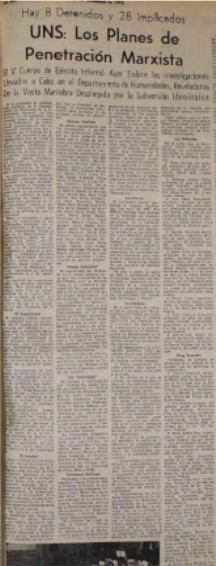
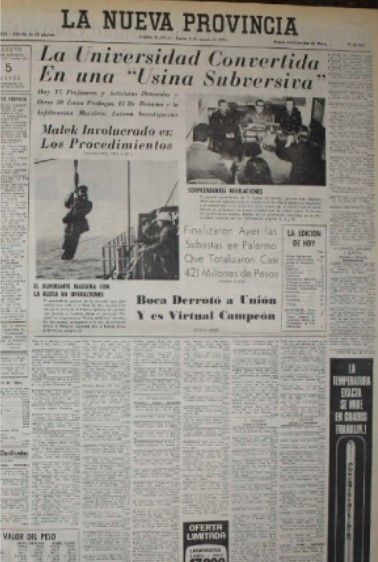
Editions of the newspaper La Nueva Provincia from November 13, 1976 (left) and August 5, 1976 (right).
Images provided by the Human Rights Unit of the Bahía Blanca Prosecutor's OfficeThe Human Rights Prosecution Unit of Bahia Blanca, composed of Chief Prosecutor Miguel Ángel Palazzani and Assistant Prosecutors Paula Molini and Pablo Fermento, requested that Federal Court No. 1 in that city refer to trial six former military officers accused of crimes against humanity and acts constituting genocide committed against 30 faculty members, students, and staff of the National University of the South (UNS) between June and November 1976, as part of a plan of political persecution during the period of state terrorism perpetrated under the last military dictatorship.
These are three former officers who were part of the command of the 5th Army Corps--Colonel Osvaldo Bernardino Páez, Major Osvaldo Lucio Sierra, and First Lieutenant Norberto Eduardo Condal -- and three former members of Intelligence Detachment 181 -- Jorge Horacio Granada, Carlos Alberto Taffarel, and Sub-Officer Víctor Raúl Aguirre.
All are charged with the crimes of breach of domicile and unlawful deprivation of liberty committed by a public official, aggravated by the fact that they were perpetrated with threats and violence and, in some cases, by their duration exceeding one month, in conjunction with the infliction of torture aggravated by political persecution. They are charged as indirect co-perpetrators, with the exception of Aguirre, who is charged as a direct co-perpetrator.
In the same case, the prosecution asked Judge Walter López da Silva to admit the organization H.I.J.O.S. Bahía Blanca, the National University of the South, and the human rights organization Equipo Nizkor as civil parties.
The 30 victims were kidnapped during operations carried out between June and November 1976. At the time, they were serving as professors of economics, literature, philosophy, history, mathematics, and biology at the UNS; they were members of the social psychopedagogy cabinet at the institution's colleges; they were professors and students at the School of Social Work; or they were part of the faculty and student body at the National College of Bahía Blanca. Some of them were forced into exile.
A criminal enterprise against the university
According to the prosecution, the kidnappings, unlawful deprivation of liberty, and torture were part of a plan of political persecution against the university community, carried out during the period of state terrorism by the armed and security forces, which benefited -- according to the prosecution's hypothesis -- of planning, coordination, and execution by the federal judiciary, as well as the collaboration of the media group then led by the daily newspaper La Nueva Provincia.
Editions of the newspaper La Nueva Provincia from November 13, 1976 (left) and August 5, 1976 (right).
Images provided by the Human Rights Unit of the Bahía Blanca Prosecutor's OfficeIn their motion, prosecutors argued that the crimes were committed "as part of a broad psychological operation that included fabricating a legal case," intended to publicly expose the victims and create the impression that the institution operated -- in the words of former commander Acdel Vilas -- as "the university of subversion."
According to the prosecution, this criminal enterprise was based on the coordinated action of three entities.
The first was the command of the 5th Army Corps and the security forces under its operational control -- including Intelligence Detachment 181 and Department II of the General Staff's Intelligence Directorate -- which carried out missions of espionage, surveillance, and recording of the activities of faculty and university staff until the kidnappings were perpetrated.
Based on this identification of targets, the military authorities devised a plan of repression against professors and university staff, encompassing both operational measures and so-called "psychological action," in which entities from the judicial and media spheres were involved.
The second institution identified by the Prosecutor's Office was the Federal Court of Bahía Blanca, which --according to the prosecution-- intervened to provide an appearance of legality to the kidnappings, interrogations, and torture. It was within this framework that legal proceedings were initiated to formally bring criminal charges against members of the university community.
In one of these cases, in addition to the 30 people who were kidnapped, another 30 professors —declared fugitives—, were identified as part of an alleged "indoctrination plan," and arrest warrants were issued against them throughout the country.
The third component of this operation was the media outlet La Nueva Provincia, which, according to the prosecution's hypothesis, carried out a psychological campaign and extensively reported on the progress of these "judicial investigations." For the prosecution, this media coverage helped to entrench in public opinion the idea that the university served to educate "subversives," to bolster the appearance of legality surrounding the repressive measures, and to encourage the public to participate in the persecution and identification of targets by monitoring and reporting individuals suspected of being subversives across various social and institutional circles.
Partial referral to trial
As part of the investigation conducted by the Prosecutor's Office, two civilians were also charged: Hugo Mario Sierra, then a clerk at the federal court, and Vicente Gonzalo Massot, head of the La Nueva Provincia media group.
However, Judge Lopez da Silva did not grant their summons as suspects, considering that it was necessary to further investigate their involvement; he therefore returned the case file to the Prosecutor’s Office —to which he had delegated the preliminary investigation— so that it could continue gathering evidence.
The public prosecutor's office appealed this decision, arguing that sufficient evidence had already been gathered to summon them to render their testimony.
Subsequently, the Federal Court of Appeals in Bahía Blanca ruled that if the court considered that further investigative measures were necessary, it should resume the investigation. In the same decision, it also dismissed the charges against five former officers of the 181st Communications Battalion who had initially been indicted by the prosecutor's office and dismissed their cases for lack of merit.
In this context, the Public Prosecutor's Office requested the partial referral to trial of the six former military personnel mentioned above, considering that the preliminary investigation in their cases was complete and ready to be addressed in an oral trial.
[Source: Human Rights Unit of the Bahía Blanca Prosecutor's Office, Office of the Attorney General of the Nation, Bahía Blanca, Argentina, 13Mar26]
* * * [Edition note: Translated into English from the original Spanish version with the help of DeepL]
 Radio Nizkor
 | This document has been published on 07Jun26 by the Equipo Nizkor and Derechos Human Rights. In accordance with Title 17 U.S.C. Section 107, this material is distributed without profit to those who have expressed a prior interest in receiving the included information for research and educational purposes. |