| Information |  | |
Derechos | Equipo Nizkor
| ||
| Information | | |
Derechos | Equipo Nizkor
| ||
15Dec24
Charges expanded to include twelve former military personnel for crimes against humanity committed against thirty teachers, students, and civil servants at the National University of the South
The defendants were charged with interference in the inviolability of home, kidnapping, and acts of torture. They were members of the 5th Army Corps command, Intelligence Detachment 181, and Communications Battalion 181. The investigation continues regarding former Federal Justice Secretary Hugo Sierra and former editor of La Nueva Provincia, Vicente Massot.
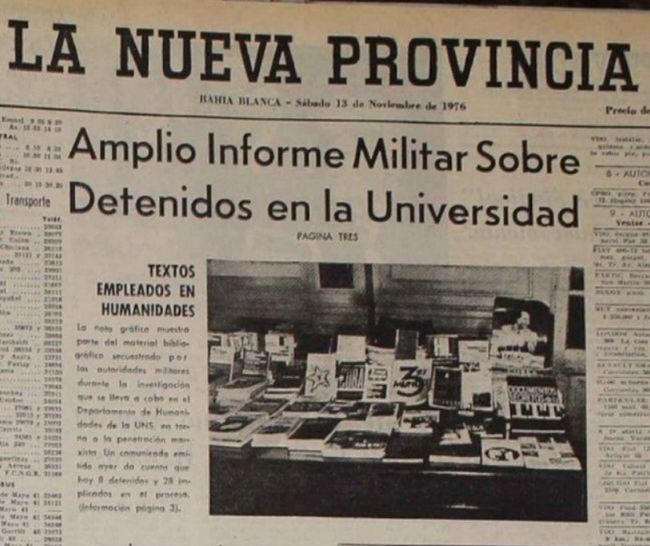
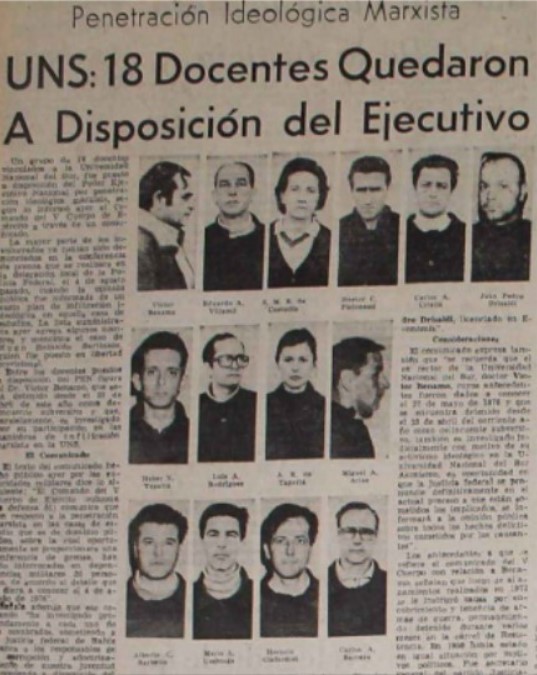
November 13, 1976, edition of La Nueva Provincia.
Image provided by the Human Rights Unit of the Bahía Blanca Prosecutor's Office
Federal Court No. 1 of Bahía Blanca extended the indictment without pretrial detention of twelve former military personnel accused of interference in the inviolability of home, aggravated unlawful deprivation of liberty, and aggravated torture committed against thirty members of the National University of the South (UNS) as part of a plan of political persecution carried out during the period of state terrorism perpetrated by the armed and security forces, which --according to the prosecutor's hypothesis, who described the case as "unprecedented"-- also benefited from the planning, coordination, and execution of the federal judiciary and the media group then led by the daily newspaper La Nueva Provincia.
The ruling, issued by Federal Judge Walter López Da Silva, extended the indictment without pretrial detention in respect of four former officers who served in the 5th Army Corps command --Colonel Osvaldo Bernardino Páez, Major Osvaldo Lucio Sierra, First Lieutenant Enrique José Del Pino, and First Lieutenant Norberto Eduardo Condal-- and three former officers of Intelligence Detachment 181 --Jorge Horacio Granada, Carlos Alberto Taffarel, and Non-Commissioned Officer Víctor Raúl Aguirre-- as well as former officers of the 181st Communications Battalion: Antonio Miguel Seghighi, Alejandro Lawless, Roberto Carlos Brunello, Raúl Esteban Andrés, and José Antonio Maidana.
The judge found that all were criminally liable for the offenses of breaking and entering and unlawful deprivation of liberty perpetrated by a public official, aggravated by the fact that they were committed with threats and violence and, in some cases, by their duration exceeding one month, in conjunction with acts of torture aggravated by the fact that the victim was persecuted for political reasons.
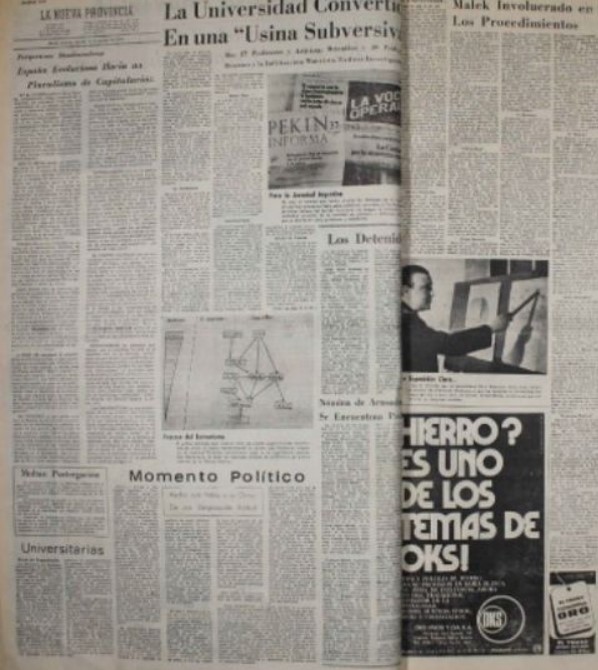
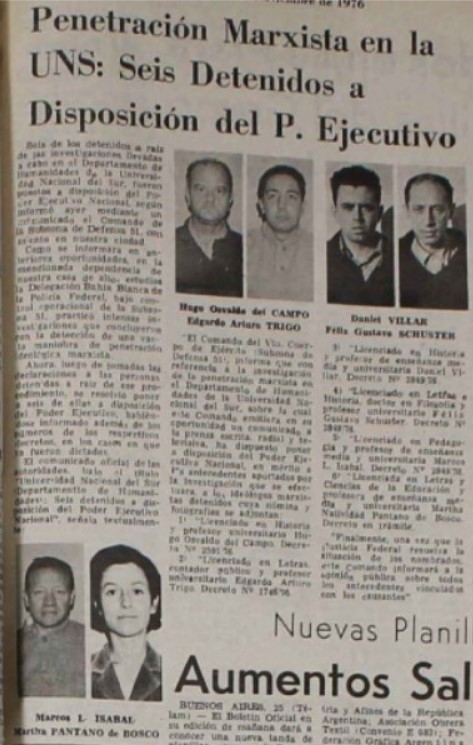
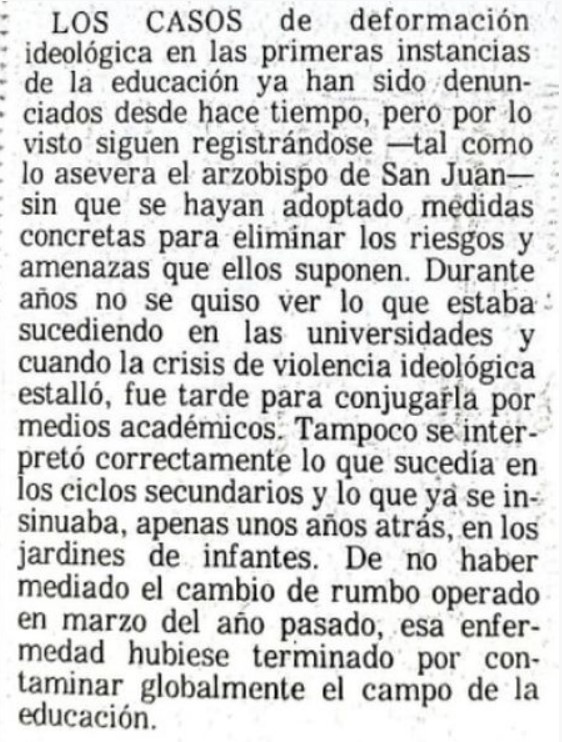
Issues of La Nueva provincia from October 27, 1976 (left) and August 5, 1976 (right).
Images provided by the Human Rights Prosecutor's Office in Bahía BlancaHe also ordered the seizure of 3 million pesos from each of them, and they will be summoned to pay the amount or surrender assets, under penalty of having their assets frozen if they fail to do so within five days of notification.
"The statistics themselves show that the newspaper's commitment to persecution, targeting, and incitement to violence against professors at the National University of the South was clearly central and direct: out of a total of 237 issues devoted to the topic of subversion, more than 80 editorials were specifically dedicated to the issue of 'subversive ideologues' in universities," the prosecutor's office stated.
In this way, the judge partially granted the request made by the Bahía Blanca Human Rights Unit of the Public Prosecutor's Office, composed of Attorney General Miguel Ángel Palazzani and Deputy Prosecutors Paula Molini and Pablo Fermento, who filed criminal charges against the former military officers as well as two civilians: the former clerk of the federal court, Hugo Mario Sierra, and the director of the local media group La Nueva Provincia, Vicente Gonzalo Massot.
Da Silva dismissed the summons of Sierra and Massot as suspects, ruling that the investigation into their cases needed to be explored further; for this reason, he referred their files to the Prosecutor's Office, to which he had delegated the preliminary investigation. The Prosecutor's Office appealed this decision, arguing that there is sufficient evidence of the defendants' criminal involvement and that the judge should have summoned them to give preliminary testimony. The Federal Court of Appeals in Bahía Blanca ordered the federal court that, if it deemed there were still investigative measures to be carried out, it should resume the investigation.
"Planned, coordinated, and executed by three entities"
According to the prosecution, "the distinctive feature of this case lies in the manner in which the attack against members of the public university was planned, coordinated, and executed by three entities --the armed forces and police, the federal judiciary, and the media-- with the purpose of publicly portraying the autonomous process of updating the curricula of the academic programs, then underway at the institution, as a mission of ideological infiltration." Similarly, the prosecution argued that "as part of this psychological operation, the victims were presented to the public as enemies of society."
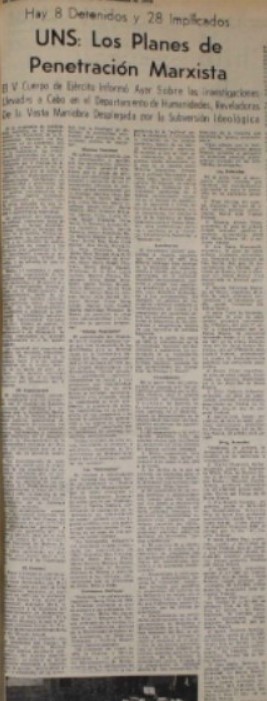
Editions of La Nueva Provincia from November 13, 1976 (left) and August 5, 1976 (right).
Images provided by the Human Rights Unit of the Bahía Blanca Prosecutor's OfficeThe thirty victims were kidnapped in operations carried out between June and November 1976. At the time, they were professors of economics, literature, philosophy, history, mathematics, and biology at the UNS; members of the social psychopedagogy cabinet at the UNS's secondary schools; faculty and students at the School of Social Work; and students and teachers at the Colegio Nacional de Bahia Blanca. Some of the victims were forced into exile.
Among them were university professors from the departments of economics, humanities, and physics at the National University of the South: Ana María Pucciarelli, Carlos Bernardo Dartiguelongue, Marcos Luis Isabal, Walter Enrique Daub, Oscar Julio Galfre, Eduardo Alfredo Villamil, Miguel Ángel Arias, Victorio Carlos Adolfo Barrera, Luis Alberto Rodríguez, Horacio Ciafardini, Mario Arnaldo Usabiaga, Carlos Alberto Cristiristiá, Juan Pedro Drisaldi, Hugo Osvaldo Del Campo, Marta Natividad Pantano de Bosco, Héctor Pistonesi, Alberto Constante Barbeito, Edgardo Arturo Trigo, and Daniel Villar.
The judge rejected the request to indict Massot and Sierra and referred their files back to the Prosecutor's Office, to which he had delegated the investigation. The Federal Prosecutor's Office appealed this decision, arguing that there is sufficient evidence against the two defendants, and the Federal Chamber instructed the judge that, if he deemed there were still investigative measures to be carried out, he should resume the investigation.
Also among the victims are former employees of this institution of higher education and former members of other university departments: Rafael Luis Laplaza, Manuel Schillizi, Dolio Heraldo Sfacia, Félix Gustavo Schuster, Mario Carlos Aggio, and María Gabriela Sartori; economics graduates Anahí Silvia Rodríguez and Heber Nazareno Tappatá; high school students Sergio Gustavo Custodio and Rodolfo Humberto Casanova; and university student Hugo Reinaldo Sartison.
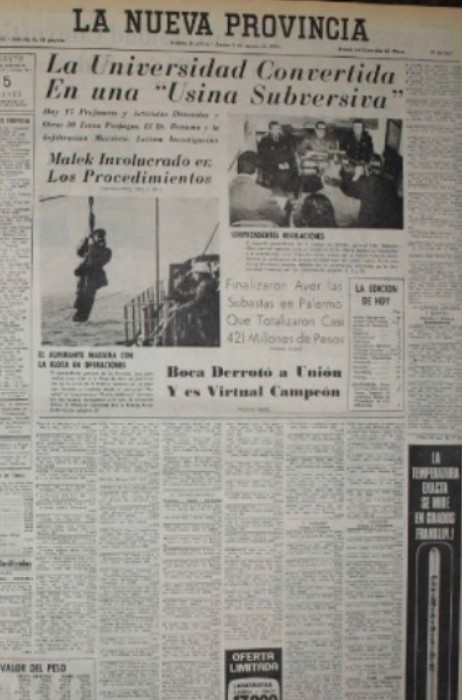
Editions of the newspaper La Nueva provincia from November 13, 1976 (left) and August 29, 1977 (right).
Images provided by the Bahía Blanca Human Rights Prosecutor's OfficeMost of the victims were transferred and imprisoned in jails located throughout the country, while Sfascia, Arias, Drisaldi, and Luis Alberto Rodríguez spent a few days at the headquarters of the 181st Communications Battalion. Ultimately, all the victims were released.
"Subversive ideologues in universities"
In its motion, the prosecution highlighted the stigmatization and incitement to genocide carried out by the newspaper La Nueva Provincia as part of the plan directed against the victims. "The statistics themselves demonstrate that the newspaper's involvement in the persecution, tergeting, and incitement to violence against UNS professors was clearly central and direct: out of a total of 237 issues devoted to the topic of subversion, more than 80 editorials were specifically dedicated to the issue of 'subversive ideologues' in universities, presented as a necessary and priority target in the fight against subversion, calling for their annihilation using the same methods as those employed against the armed guerrillas," the prosecutor's office stated when requesting the opening of a preliminary investigation against the defendants.
The prosecutor's submission also highlighted the coordinated efforts between core publications and newspapers —featuring front pages with banner headlines and leading stories—, the progress of legal proceedings brought by the federal court against members of the academic community, and the actions of the repressive forces. In this regard, it emphasized that the kidnappings and torture were made possible by the "relevant and necessary contributions" of officials in the federal judiciary at the time, including, in addition to Sierra, Judges Guillermo Federico Madueño and Jorge Francisco Suter, as well as Federal Prosecutor María del Carmen Valdunciel de Moroni.
As an example of the synchronization and alignment with the indispensable contributions of the daily newspaper La Nueva Provincia, the prosecutors cited excerpts from a ruling issued by Judge Suter and published by the newspaper under headlines such as "The Country Facing Subversion," "Subversion in the Academic World," "Overview of the Situation at the UNS in 1973/74," and "Academic Freedom and Ideological Infiltration."
[Source: Human Rights Unit of the Bahía Blanca Prosecutor's Office, Office of the Attorney General of the Nation, Bahía Blanca, Argentina, 15Dec24]
 Radio Nizkor
 | This document has been published on 03Jun26 by the Equipo Nizkor and Derechos Human Rights. In accordance with Title 17 U.S.C. Section 107, this material is distributed without profit to those who have expressed a prior interest in receiving the included information for research and educational purposes. |